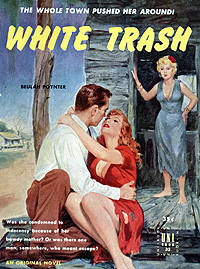
"Mattie Horn might be bawdy and direputable--but she was still beautiful enough to draw the town's most respected citizens down to the Hollow where she lived. And if her own charms failed, there was always her daughter Hagar--not yet eighteen, and pretty as a picture. The trouble was, Hagar wanted to be a respectable citizen herself. Tiring of visits on the sly, she took up right out in public with the preacher's son. Her boldness, and a slight dip into sin by Deacon Elihu Spry, brought down the wrath of the whole brutal community on the heads of the scarlet woman and her daughter"
Interestingly IMDB has a listing for an actress of the silent era called Beulah Poynter, born 1886. WHITE TRASH was published in 1952, making silent Beulah 66 at the time, if I can still add up in my head OK. Wouldn't it be great if they were one and the same?

Friday, November 05, 2010
Pulp of the Day: WHITE TRASH by Beulah Poynter
Wednesday, August 11, 2010
Pulp of the day: HORRIFIC


Pulp ain't just about books. Comics weighed down the news-stands alongside their text-only cousins. Maybe they weren't quite as sleazy but they were just a gruesome and lurid in other ways. And one overriding vibe dominated them all - the weird. Saying that, I wasn't there, so how would I know? I'm just making this up - ignore me. But don't ignore these great covers from 1953 issues of HORRIFIC. As you can see, they used the same model for all of them!
Monday, August 09, 2010
Pulp of the Day: THE BASTARD by Erskine Caldwell

First published way back in 1929, THE BASTARD was the debut of Erskine Caldwell, an author who went on to achieve fame and huge sales with TOBACCO ROAD and GOD'S LITTLE ACRE. THE BASTARD was banned upon publication and Caldwell's personal copies seized. Even by today's standards, the misogyny and casual racism makes this a rough read, but it is written with the pace and forward propulsion that pulp became known for in the thirty or so subsequent years (even if Caldwell himself isn't always associated with the genre). And the author set off on his writing career with the same objective that carried him through it - telling it like he saw it.